Building a social platform for player matchmaking and community engagement

A community-driven platform connecting players through intelligent matchmaking, social interaction, and long-term engagement systems.

Overview

Project codename: NEXUS

This is a case study used to demonstrate social platform architecture for gaming communities and structured matchmaking systems.

Modern multiplayer ecosystems are fragmented across games, platforms, and communication tools.

Players rely on external chats, inconsistent LFG posts, and unreliable matchmaking channels, which makes forming stable groups difficult and shortens engagement cycles.

NEXUS was designed as a unified LFG and social layer that structures how players discover each other, form groups, and maintain ongoing connections.

The objective was not only to match players, but to build continuity between sessions and strengthen long-term community formation.

The Challenge

Most gaming communities lack structured social infrastructure.

As a result, multiplayer experiences often fail at the social layer rather than the gameplay layer.

Common issues include:

  • Fragmented LFG across Discord, forums, and in-game chat
  • Low-quality or mismatched group formation
  • No persistent player reputation or context
  • Weak retention of group relationships after sessions
  • High toxicity and low trust between strangers

The core challenge

was to make player connection structured, contextual, and repeatable.

System Goals

The platform was designed around four core objectives.

This included:

  • Improve accuracy of player-to-player matchmaking
  • Increase retention of groups beyond single sessions
  • Introduce structured social identity and reputation
  • Centralize communication and discovery into one system

Every design decision followed a simple rule:

Does this improve the quality of human connection in gameplay sessions?

Designing the Social Matchmaking System

The system was structured around a layered social and matchmaking architecture.

Intelligent Matchmaking Layer

Players are matched using structured filters beyond basic skill level. The system considers game preferences, roles, communication style, and behavioral patterns. This produces more compatible groups with higher long-term cohesion.

Social Identity Layer

Each player has a persistent profile that extends beyond a single game session. It includes play history, roles, preferences, and behavioral signals. This creates continuity and context across all interactions.

Session & Party System

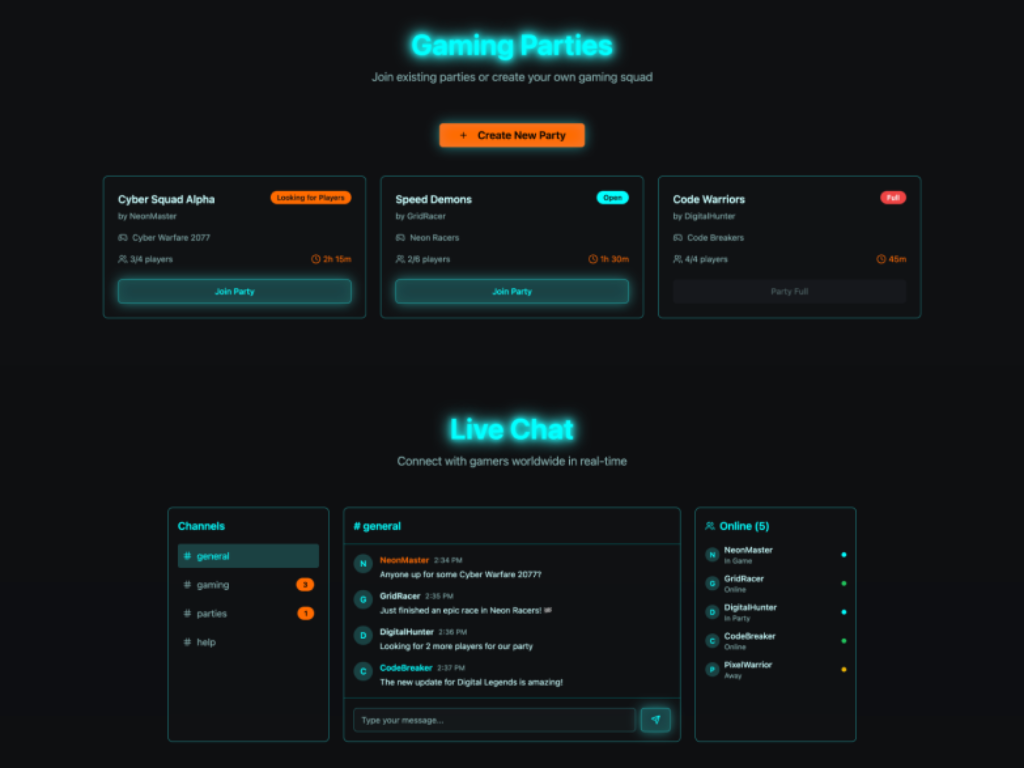
Instead of one-off matches, players form structured parties. These parties can persist across sessions, allowing groups to evolve over time. This shifts gameplay from random matchmaking to repeatable social units.

Community Interaction Layer

The platform includes social features that extend beyond matchmaking. Players can post, discover groups, and interact through a structured feed. Community signals help surface active and trustworthy players, reducing friction in group formation.

Core System Components

  • Matchmaking engine with multi-factor filtering
  • Persistent player identity and profile system
  • Party and session continuity framework
  • Community feed and interaction layer
  • Reputation and behavior tracking system
  • Communication layer integrated with group formation

Each component operates independently while contributing to a unified social ecosystem.

Key Design Principles

  • Connection before speed
  • Context before matching
  • Continuity before sessions
  • Trust before anonymity
  • Structure before randomness

These principles ensure the system prioritizes meaningful social formation over instant matchmaking.

Outcome

The resulting system creates:

Higher-quality player matches with better compatibility

Increased retention through persistent groups

Reduced friction in forming multiplayer sessions

Stronger social identity across gaming activity

A scalable framework for cross-game communities

Faster iteration cycles

NEXUS demonstrates how matchmaking can evolve from transactional pairing into structured social infrastructure.

Lessons Learned

Most multiplayer systems optimize for speed of matchmaking, not quality of connection.

If player relationships are not persisted, the platform resets value after every session.

When social structure is missing, players constantly reset relationships instead of building them.

Final Thoughts

Project NEXUS demonstrates a structured approach to social gaming architecture centered on matchmaking intelligence and community continuity.

By aligning identity, matchmaking, and social interaction into a unified system, the platform transforms isolated game sessions into continuous social networks.

This approach does not scale by increasing matches – it scales by increasing meaningful player relationships.

GET STARTED

BUILDING SOMETHING AMBITIOUS?

Let’s design and build a digital product system that is ready to scale.