Overview
Project codename: Lumen
This is a conceptual case study used to demonstrate SaaS architecture and dashboard system design principles.
Modern SaaS products tend to accumulate complexity as they scale.
As feature sets expand, user workflows become fragmented, key data becomes harder to access, and teams lose visibility over system state.
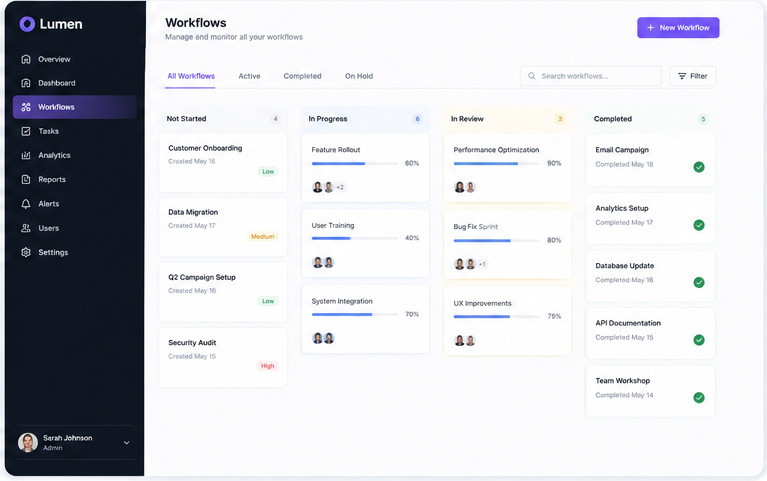
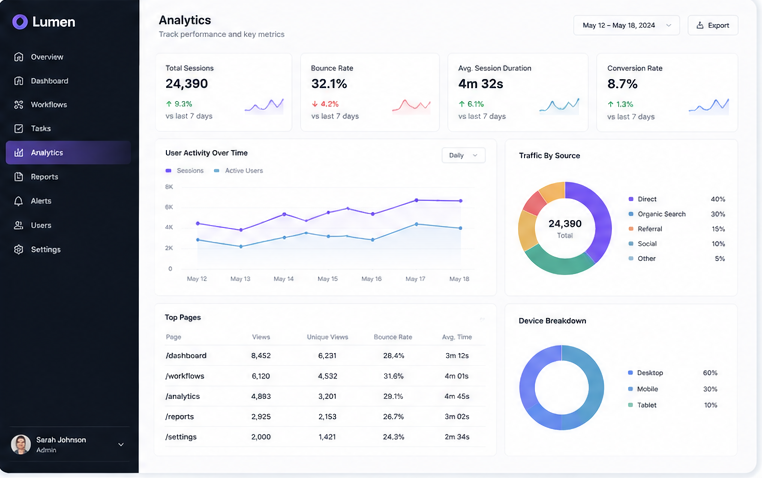
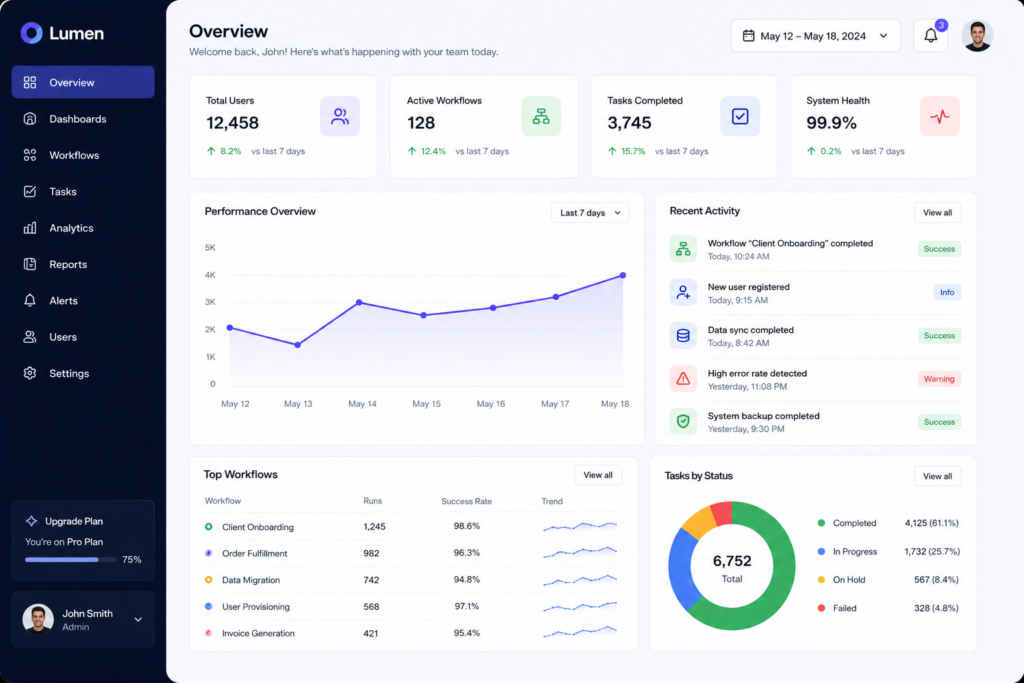
Project Lumen was designed as a dashboard-first SaaS architecture focused on clarity, structured data access, and workflow alignment.
The objective was not to add more functionality, but to make existing system data understandable, actionable, and immediately usable.
The Challenge
Most SaaS platforms struggle to maintain usability as they scale.
As a result, users spend more time navigating the system than using it effectively.
Common issues include:
- Fragmented workflows across multiple product areas
- Lack of centralized visibility into key metrics
- Overloaded interfaces with low signal-to-noise ratio
- Weak alignment between user actions and business outcomes
- Difficulty interpreting system state in real time
The goal
was to design a system where data directly drives action and clarity.
System Goals
The platform was designed around four core objectives:
This included:
- Centralize critical operational and user data
- Reduce friction across core user workflows
- Enable real-time decision-making through dashboards
- Ensure scalability across expanding feature sets
Every design decision followed a simple rule: Does this improve clarity or add cognitive load?
Designing the Dashboard System
The system was structured around a modular, dashboard-first architecture.
Unified Data Layer
All system data was normalized into a single structured layer to ensure consistency across dashboards and views.
This created a unified foundation for reliable data access and interpretation.
Role-Based Dashboards
Different user types interact with the system through tailored perspectives based on their responsibilities.
Operators focus on execution, managers on performance oversight, and administrators on system-wide analytics.
Workflow-Centric Architecture
Instead of organizing the product around isolated features, the system was structured around core user workflows.
This ensured that every interaction was tied directly to meaningful operational context and purpose.
Real-Time Visibility Layer
The system was designed to reflect live state changes across all critical components.
This enabled users to respond to events immediately without relying on delayed reporting cycles.
Core System Components
During the MVP planning phase, the following outputs were produced:
- Dashboard rendering engine (modular UI system)
- Centralized data aggregation layer
- Role-based access and permission system
- Workflow tracking and state engine
- Metrics and analytics framework
- Event-driven notification system
Each component operates independently while contributing to a unified system experience.
Key Design Principles
- Clarity over complexity
- Data before interface
- Workflows before features
- Modularity over monoliths
- Visibility over abstraction
These principles ensured the system remained scalable and maintainable under growth.
Outcome
The resulting system provides:
A unified operational dashboard experience
Faster access to actionable insights
Reduced cognitive load for users
Improved decision-making speed
A scalable foundation for SaaS expansion
Faster iteration cycles
The system demonstrates how dashboard-first architecture can transform fragmented SaaS products into coherent operational platforms.
Lessons Learned
Dashboards are not visual layers – they are decision environments.
If users cannot interpret system state instantly, scalability breaks at the product level.
When designed properly, they become the operational core of a SaaS product.
Final Thoughts
Project Lumen demonstrates a SaaS architecture approach centered on clarity, structure, and usability.
By aligning data, workflows, and user roles into a single coherent system, the platform enables faster and more confident decision-making.
This approach does not scale by adding features – it scales by improving understanding.
GET STARTED
BUILDING SOMETHING AMBITIOUS?
Let’s design and build a digital product system that is ready to scale.